
F-350 Fuel Economy With a Camper: Gas vs Diesel

Updated: Nov 2
Part of our Ford F-350 Overland Hunting Build series.
Our last mountain trip cost roughly $340 in diesel.
That was for a trip of almost 1,000 kilometres. With retirement finally here, Justine and I have more time to get our family out on the road. The kids have time. The camper is on the truck. We would love to do more of this. The fuel bill has other ideas.
I bought our diesel F-350 knowing it would eventually wear bigger tires and carry a camper. Diesel made sense for the truck I wanted to build. But with gasoline at $1.59 per litre and the diesel price used in this comparison at $2.28, I wanted to check whether that decision still made sense for our travel budget.
So I opened the spreadsheets to compare our F-350 fuel economy on stock tires, corrected-speedometer 37s and the Yucca-Pac camper setup, then worked out what a gas truck would need to match our fuel and DEF costs.
A note for our American readers: All prices in this article are Canadian dollars, including prices converted to US gallons. MPG figures use US gallons, not Imperial gallons. The price comparison is an October 2026 snapshot, rather than a live fuel-price feed.
Why We Chose Diesel for Jolene
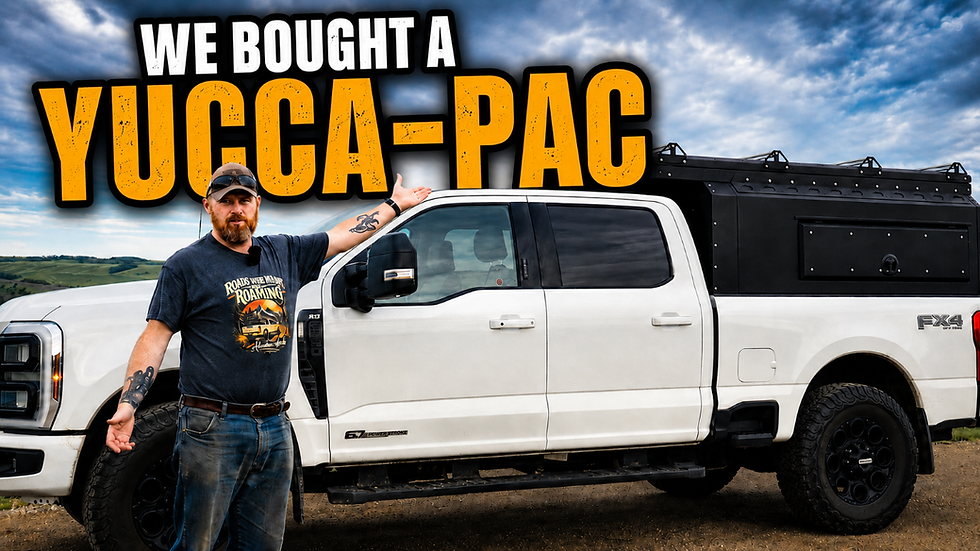
Jolene is our 2024 Ford F-350 with the 6.7L Power Stroke diesel. She now runs 37x12.50R20 BFGoodrich KO2s on the factory wheels, with no lift, and carries our Yucca-Pac Safari camper.
The plan was always to build a truck for hunting, mountain trips and travelling with our family of six. Bigger tires and a camper were part of that plan, so I considered fuel consumption and the way we intended to use the truck when choosing the engine.
The Safari added approximately 463 pounds when installed. That is before accounting for the bedding, food, clothing, power equipment and everything else we bring camping.
You can see why we chose that platform in our Yucca-Pac Safari camper walkthrough. We have also shown how all six of us actually sleep inside it.
The truck is doing the job we bought it for. The question is what that job costs every time we leave home.
How I Calculated These Fuel Economy Numbers
These figures come from recorded fill-ups, using the distance travelled and litres going back into the truck.
For each setup, I added the litres and kilometres together, then calculated:
Total litres ÷ total kilometres × 100 = overall L/100 km
That gives every kilometre equal weight. Averaging the individual fill-up results would give a short 146-kilometre interval the same influence as a 902-kilometre interval.
This is still mixed, real-world use. Highway driving, short trips, mountain travel and everyday running around all remain in the records.
The periods cover different seasons, routes and loads, though. These are ownership results, not a controlled test that can separate the exact effect of tires, camper weight, weather and driving conditions.
Fuel Economy With the Factory Tires
The stock-tire period from 2025 covered 23,895.1 kilometres, or 14,847.7 miles.
Across that distance, we recorded 3,010.24 litres, approximately 795.22 US gallons, giving an overall result of:
12.60 L/100 km / 18.7 US MPG
For a truck this size, I am happy with that.
Comparable recorded pump prices in that period ranged from $1.29 to $1.74 per litre, or approximately CAD $4.88 to $6.59 per US gallon.

If you read our earlier 37s-versus-33s fuel economy comparison, that article concentrated on February and March. This update uses a longer stock-tire period and calculates consumption from the combined litres and distance. Different reporting windows and averaging methods can produce different results.
Fuel Economy on 37s With the Speedometer Corrected
For the next comparison, I used the supplied pre-camper record grouping beginning with the first complete fill-up interval after the January speedometer adjustment. The initial adjustment entries are excluded.
That leaves 6,595.3 kilometres, or 4,098.1 miles, using 972.17 litres, approximately 256.82 US gallons.
The result was:
14.74 L/100 km / 16.0 US MPG
That is higher consumption than the longer stock-tire sample. Because those periods include different driving and conditions, I cannot assign the entire difference to the tires alone.
If you are working through the same tire change, our FORScan speedometer recalibration guide explains what we changed and how we checked it against GPS.

F-350 Fuel Economy With the Yucca-Pac Camper
The full camper table used in the video covers 7,775.5 kilometres, or 4,831.5 miles, and 1,143.03 litres, approximately 301.96 US gallons.
That works out to:
14.70 L/100 km / 16.0 US MPG
The camper stays bolted on, so this includes everyday use as well as our longer adventures. It is not a highway-only number with the less flattering driving removed.
The overall result is almost identical to the 37s sample immediately above.
That is encouraging, but it does not establish that the camper adds no fuel consumption. The driving mix changed between the periods. We have added weight and changed the truck's profile, without holding everything else constant.
What the records show is that this camper setup averaged about 14.7 L/100 km over the distance recorded.

Some of Our Best Fuel Economy With the Camper
The overall result also hides a fairly wide spread between fill-ups.
Here are a few examples from the camper log:
Fill-up date | Distance since previous fill | L/100 km | US MPG |
July 10, 2026 | 464.5 km | 12.17 | 19.3 |
August 5, 2026 | 490.7 km | 12.56 | 18.7 |
August 25, 2026 | 526.7 km | 13.00 | 18.1 |
June 21, 2026, Expo wind/weather note | 901.8 km | 13.51 | 17.4 |
September 20, 2026 | 174.5 km | 19.95 | 11.8 |
Our best recorded camper interval was 12.17 L/100 km, or about 19.3 US MPG. The highest consumption was almost 20 L/100 km.
Those are individual fill-up intervals. They are not necessarily complete trips, and they do not establish what the truck will use on your route.
Show only the best result and this truck looks remarkably economical. Show only the highest-consumption interval and you would get a very different impression.
Both belong in the record.
Wind and Weather Need to Be Part of the Conversation
The Expo interval is a useful example because I specifically noted major wind and weather alongside it.
Over 901.8 kilometres, that interval worked out to 13.51 L/100 km. Despite the weather note, it was still below our overall camper average.
hat does not mean the wind helped us, or that weather does not matter. It means several things were happening during the same interval, and the final fuel receipt cannot separate them.
Wind resistance is a real part of a vehicle's energy demand. The US Department of Energy identifies aerodynamic drag and wind resistance among the losses it studies in heavy-vehicle efficiency. FuelEconomy.gov also identifies higher road speeds and external roof cargo as factors that can reduce economy. Those general findings do not tell us the precise penalty for our particular camper.
When comparing our trips, I want to know whether we had a headwind or tailwind, how much time we spent on the highway, whether we were climbing through the mountains, and what we were carrying.
We have not logged controlled wind measurements or repeated an identical route with every setup. I cannot put a reliable number on the weather penalty.
The useful result is the range we have actually recorded, with the conditions included wherever we noted them.
The Fuel Economy Stayed Similar. The Trip Cost Did Not.
During the camper period, recorded diesel prices ranged from $1.57 to $2.70 per litre.
That is approximately CAD $5.94 to $10.22 per US gallon.
Using the same overall camper consumption for an illustrative 1,000-kilometre trip:
At $1.62/L, diesel would cost approximately $238.
At $2.28/L, it would cost approximately $335.
At $2.70/L, it would cost approximately $397.
Those examples hold distance and consumption constant. They are not the exact bills from three identical trips.
Between $1.62 and $2.28 per litre, the same thousand kilometres costs nearly $97 more, even if the truck uses exactly the same amount of fuel.
That is what started this conversation. Another hundred dollars at the pump comes directly out of what we can spend getting our family outside.
DEF Belongs in the Running Costs Too
Yes, I keep DEF records as well. Apparently, a fuel spreadsheet was not enough.
For the latest recorded DEF interval, we travelled 4,205 kilometres, added 16.85 litres, and spent $21.92.
That works out to approximately:
0.401 litres per 100 km
0.170 US gallons per 100 miles
0.52 Canadian cents per kilometre
0.84 Canadian cents per mile
Over a thousand kilometres, that is roughly $5.21.

Recorded DEF use has increased across the last three refill intervals, from approximately 0.30 to 0.38 to 0.40 L/100 km. Those intervals do not form a clean camper-only comparison, and top-up consistency matters, so I am not assigning the increase entirely to the camper.
Diesel is still the much larger expense. DEF is simply another cost of covering the distance, so it belongs in this calculation.
What Fuel Economy Would a Gas F-350 Need?
The prices used in the video are:
Gasoline: $1.59/L / CAD $6.02 per US gallon
Diesel: $2.28/L / CAD $8.63 per US gallon
At our measured camper consumption, diesel costs approximately $33.52 per 100 km. Add the latest DEF cost allowance and the combined running cost becomes approximately $34.04 per 100 km.
Divide that cost by gasoline at $1.59 per litre, using the unrounded values, and the gas truck's matching consumption is:
21.41 L/100 km / 10.99 US MPG
A gas truck using less than that many litres per hundred, or getting more miles per gallon, would be cheaper on fuel than our diesel plus DEF at those prices.
At the exact break-even point, the costs match.

The pump-price gap matters just as much as the difference in litres used. Change either fuel price and this threshold changes too.
What About the 7.3L Gas Engine?
Owner reports give us useful examples, but they do not tell me exactly what a gas version of Jolene would use with our tires, camper and family load.
For example, one owner of a 2022 F-350 7.3 gas with stock tires and 4.30 gears reported 12–13 US MPG on road trips. That is approximately 18.1–19.6 L/100 km. Other modified and camper-equipped trucks in that discussion reported lower MPG.
Using 12 and 13 MPG as examples gives this comparison:
Setup or example | Consumption | Fuel cost per 100 km |
Our diesel camper setup, including DEF allowance | 14.70 L/100 km / 16.0 US MPG | $34.04 |
Gas truck achieving 12 US MPG | 19.60 L/100 km | $31.17 |
Gas truck achieving 13 US MPG | 18.09 L/100 km | $28.77 |
At those results and prices, the gas examples would save approximately $29–$53 over 1,000 kilometres.
That saving is separate from the nearly $100 increase caused by the diesel price change earlier in the article. It is not a promise that switching engines saves $100 every trip.
The remaining question is whether a comparable gas truck can deliver those figures with the same kind of load and travel.
Did We Buy the Wrong Truck?
I am still happy with Jolene.
We chose diesel for the truck we intended to build, and our records show that it can travel with the 37s and camper without a dramatic overall consumption increase between the two later samples.
What I cannot say is that diesel automatically costs less to drive.
At the prices used here, a gas truck does not need to match our diesel's MPG to match its fuel and DEF bill. That is a meaningful difference when the goal is putting more kilometres behind us as a family.
Purchase price, servicing, repairs, towing requirements and the rest of ownership still matter. This article answers the narrower question of what it costs to keep moving down the road on fuel and DEF. There is also something the cost comparison does not show: how far each tank takes us.
Our short-bed F-350 has a 128.7-litre tank, or 34 US gallons, the same capacity as the equivalent gas truck. Using our recorded diesel consumption and the gas examples discussed above gives us this comparison:
Setup or example | Consumption | US MPG | Estimated range per tank |
Our diesel with 37s and camper | 14.70 L/100 km | 16.0 | 875 km / 544 miles |
Gas truck achieving 12 MPG | 19.60 L/100 km | 12.0 | 657 km / 408 miles |
Gas truck achieving 13 MPG | 18.09 L/100 km | 13.0 | 711 km / 442 miles |
These estimates use the full rated tank capacity. We would fill up sooner to leave a reserve, and actual range varies with driving conditions.
That gives our diesel approximately 164–219 kilometres, or 102–136 miles, more range than these gas examples.
With four kids, we are usually stopping long before the truck needs fuel anyway. Someone needs a bathroom, a snack or a chance to move around.
What the extra range gives us is more choice about where we fill up. We can stop for the kids without needing to buy fuel, and have more flexibility to pass an expensive station for a better option farther down the road. That does not automatically erase the higher diesel cost, but it is an advantage we still value.
We will keep recording the numbers as the build and our travel continue.
Join the Conversation
Are you running gas or diesel?
If you have a gas Super Duty, especially a 7.3 with larger tires and a camper, I would like to hear your calculated fuel economy. Include your tire size, camper or towing load, and whether the figures are mainly highway or everyday mixed driving.
Tell us whether you calculated it from fill-ups or used the dash display, and specify US or Imperial gallons if you report MPG.
If you want a closer look at the spreadsheets behind our numbers, leave a comment.
Support The Baker Adventures
Now that retirement is here, we are putting more time into the truck builds, gear reviews and adventures we share.
If you find the testing useful, you can support the next trip through The Baker Adventures merchandise shop. There are shirts, mugs and a few questionable ideas that made it far enough to become merchandise.
You can follow the rest of Jolene's F-350 overland hunting build as we keep working out what makes this setup useful for our family.

Comments